


Any changes in the shape and color of your nails may indicate the presence of a fungal infection.In medicine they are called onychomycosis, popularly – nail fungus.If detected in the early stage, there is a high probability of rapid recovery;advanced forms can be treated for years and not always with positive success.It is worth noting that onychomycosis is common throughout the world, and in Russia it occurs in 7-16% of residents.Their presence is closely related to many factors, ranging from social characteristics to individual characteristics of the body.
What does nail fungus look like in the early stage?
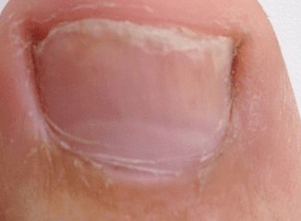
Almost always, the initial stage of nail mycosis is asymptomatic, especially on the feet.Only occasionally can small yellow spots be observed on the nail plate or a slight itching may be felt on the finger.Almost always, the lesion begins with the 1st and 5th toes and presents changes:
- Nail colors (yellow, shades of brown);
- Shape of the nail plate (thickening or vice versa – thinning is observed);
- Deformation (appearance of longitudinal and transverse yellow or white stripes).
In addition to all the visible changes, subjective sensations in the form of itching and soreness may be added.
Note!Onychomycosis is more common on the legs, less often on the arms.Most often it appears as a result of an injury during a manicure or pedicure, if the patient is already sick with mycosis of the feet.
Classification of onychomycosis
Today it is customary to classify onychomycosis not only taking into account the clinical characteristics of damage to the nail plate, but also based on the variants of penetration of fungi into it.The following types of onychomycosis are distinguished:
- distal;
- distal-lateral;
- superficial white;
- proximal subungual;
- total dystrophic.
The first two forms are the most common, since in them the pathogen penetrates the nail from the affected skin of the feet.They are characterized by a long course, in which the lesion process slowly spreads over the entire nail in the form of an oval yellow spot or a chip.
A distinctive feature of white superficial onychomycosis is damage to the nails of the first fingers in the initial stage.Damage to the matrix and nail bed is extremely rare;essentially the entire process is limited to the appearance of superficial white lesions.
The last two forms are very rare and are characterized by a rapid course, in which the matrix and the periungual crest are affected.A distinctive feature is partial or complete destruction of the nail plate.
Nail fungus pathogens are also divided into three groups:
- dermatophytes;
- yeast fungi of the genus Candida;
- mold.
The first two types are much more common, and their clinical picture is clearly expressed by damage not only to the nail plate, but also to the feet.
Fundamental factors for the development of onychomycosis
Many people wonder why we all visit baths, saunas, swimming pools, beaches, in the end, but only some of us get infected with nail fungus.The fact is that for the proliferation of fungi not only a favorable environment is needed, but also weakened protective functions of the body.At risk are people who have problems with:
- vessels of the lower limbs;
- overweight;
- flat feet and foot deformities;
- increased blood glucose levels, which is used by fungi for metabolic processes;
Onychomycosis is common in adults and practically never occurs in children.One in two people over the age of 70 develops toenail or fingernail fungus.
How to treat nail fungus in the early stage?
If you suspect nail fungus, you should immediately consult a dermatologist.At least to identify the pathogen and select an effective antifungal drug.Most modern drugs are very harmful to the liver and tests are carried out before they are prescribed.If problems are detected, the drug is replaced with another.
Toenail fungus treatment at home is acceptable if you know the pathogen and are in the early stage.So, following the rules of disinfection (processing of underwear, socks, shoes, treatment of the nail plate, etc.), you can quickly get rid of the disease even without taking systemic drugs.
With the treatment of advanced nail fungus, everything is much more complicated, since here you have to fight not only the external manifestations of the disease, but also expel the pathogen from the body.Here, in addition to attention, the patient will need patience and time, since therapy can last for years.
If for some reason you do not have the opportunity to seek help from a specialist, when you detect the first signs of nail fungus, you can lubricate the affected areas with iodine and hydrogen peroxide, which are considered effective in the fight against dermatophytes and candida.It is recommended to treat the entire nail in the morning with iodine and in the evening with hydrogen peroxide for a month.Before treatment, wash your feet, dry them and cut as much of the affected nail as possible.